
Technical experts are trained to value precision, completeness, and accuracy. These are essential qualities when building systems, writing code, or solving complex problems.
They are less helpful, however, when communicating with senior leaders.
In executive settings, the goal is not to convey everything you know. It is to ensure that the right message is understood quickly, in a way that supports decision-making.
This is where many technical updates fall short. Not because the work lacks rigor, but because the message is framed in a way that makes it difficult for a non-technical audience to engage.
A more effective approach to prepare an executive-level technical update is to build your message deliberately—starting not with the content, but with the audience. The framework below provides a practical way to do this, moving from the inside out.
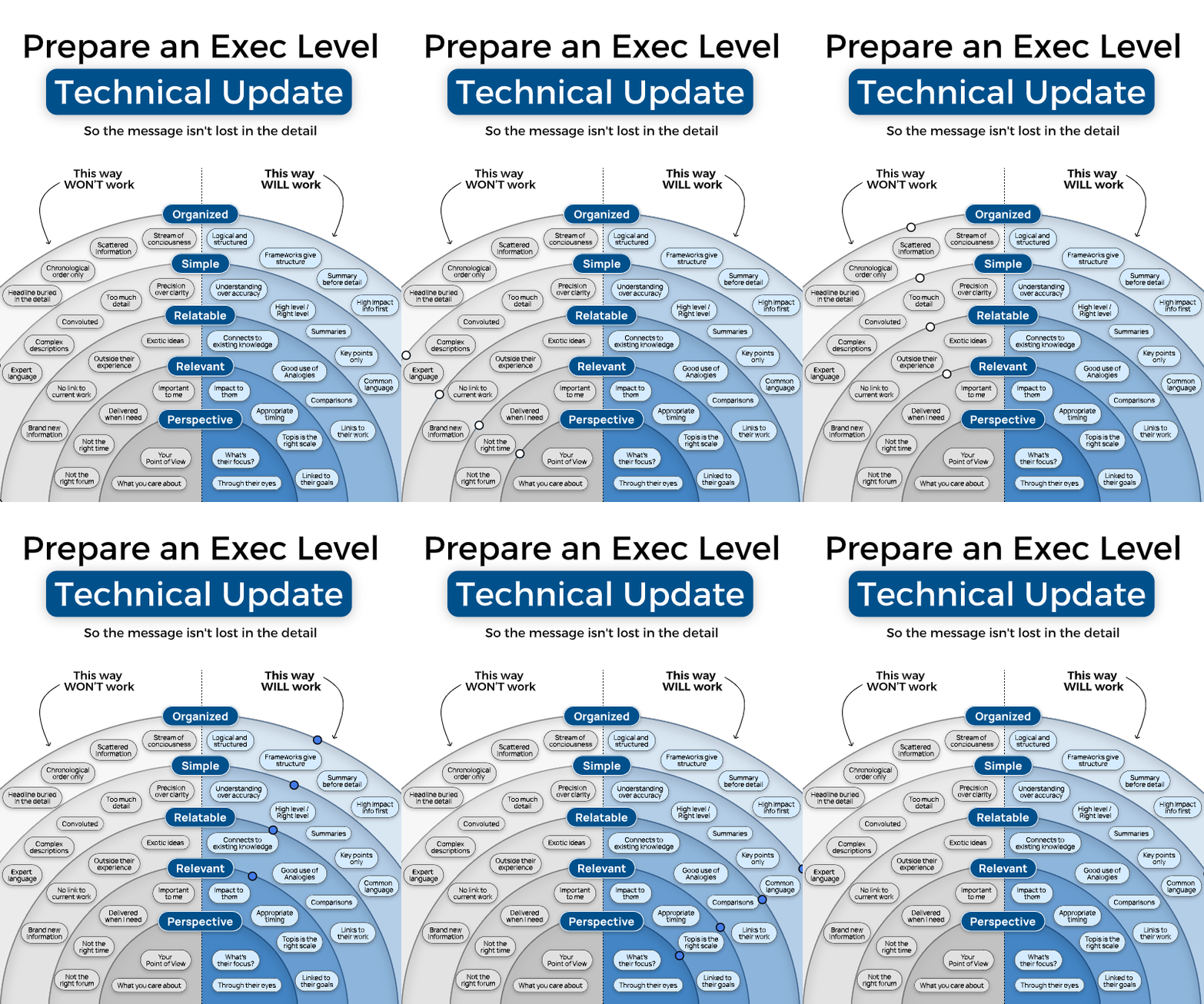
1. Start with Perspective: Anchor in Their Priorities
Effective executive communication begins with perspective, specifically, the perspective of your audience.
Senior leaders are typically focused on:
- Business outcomes
- Risk and exposure
- Cost and resource allocation
- Speed and delivery timelines
- Strategic alignment
They are not focused on the technical components of your work.
When updates are framed from the communicator’s point of view (“what we built,” “what we changed”), they require the audience to translate that information into business implications themselves. In practice, this rarely happens.
A more effective approach is to begin with their priorities:
What does this mean for the business?
What does this require from them?
This shift in perspective is foundational. Without it, the rest of the message is unlikley to land.
2. Establish Relevance: Make the Impact Explicit
Once you are anchored in the audience’s perspective, the next step is to establish relevance.
Relevance is not obvious, it must be demonstrated.
For senior leaders, relevance is typically expressed through impact. This could be impact on:
- Time (delays, acceleration)
- Cost (investment, savings, overruns)
- Risk (technical, operational, regulatory)
- Outcomes (quality, performance, customer experience, finances)
Consider the difference:
- “We refactored the service to improve modularity.”
- “This change reduces future development time by approximately 30% and lowers the risk of release-related outages.”
Both statements describe the same work. Only one makes the impact explicit.
When relevance is unclear, executives either disengage or ask a bunch of questions to try and find it. In both cases, the effectiveness of the update is reduced.
3. Make It Relatable: Translate Technical Concepts into Shared Understanding
Technical accuracy is important, but in executive communication, it must be balanced with accessibility.
Senior leaders often operate outside the technical domain. As a result, even well-structured explanations can fail if they rely heavily on specialized language or unfamiliar concepts.
This does not require “simplifying” the work in a way that removes substance. Rather, it requires translating it into terms the audience can readily understand.
This can include:
- Using common, non-specialist language
- Connecting new concepts to familiar ideas
- Employing analogies or comparisons where appropriate
For example:
- “We implemented eventual consistency across services.”
- “Updates now take a few seconds to synchronize across systems, which slightly delays visibility but improves overall system reliability.”
The second version maintains accuracy while prioritizing understanding.
4. Keep It Simple: Prioritize Clarity Over Completeness
A common challenge for technical experts is the instinct to include all relevant detail.
In executive settings, this approach is counterproductive.
Senior leaders do not need a comprehensive account of the work. They need:
- The key message
- The implications
- The path forward
Clarity, in this context, is achieved by choosing what to leave out.
This includes:
- Focusing on a small number of key points
- Presenting information at the appropriate level of detail
- Leading with summaries rather than building toward them
A useful guideline is to aim for a message that can be understood quickly, without requiring significant effort from the audience.
5. Organize the Message: Provide a Clear Structure for Decision-Making
Once the message is aligned with perspective, relevance, relatability, and simplicity, it must be organized in a way that is easy to follow.
Unstructured or “stream of consciousness” updates force the audience to work harder to identify what matters. A clear structure reduces this cognitive load and supports faster understanding.
A practical structure for executive updates includes:
- Topic and goal — What is this about, and what are we trying to achieve?
- Current status — Where are we now?
- Impact — What does this mean for the business?
- Timing — When will this affect outcomes?
- Next steps and ask — What happens next, and what is needed?
For example:
“I have an update on the payments platform. Our goal is to improve transaction reliability, and we’ve identified an issue that could delay progress. This may impact the release timeline by two to three weeks and increase costs if not addressed. We expect this to affect the June milestone. Our next steps are to test two solutions, and I am requesting approval to allocate additional engineering support.”
This structure ensures that the audience can quickly grasp the situation and respond appropriately.
From Technical Detail to Executive Clarity
The most effective executive updates are not those with the most information, but those that are most aligned with how senior leaders think and make decisions.
Prepare an executive-level technical update from the inside out: starting with perspective, then establishing relevance, making it relatable, keeping it simple, and finally organizing it. Do this and you increase the likelihood that your message will be understood and acted upon.
Technical expertise ensures the work is sound.
Clear, audience-centered communication ensures the work has impact.